
ACBSP Accreditation
Student Performance Tracking Processes Results
Student Enrollment by program and year: Student enrollment rates are tracked by the School of Business annually. Data reported by the Office of Institutional Research and Advancement for seven academic years [Fall 2019- Spring 2026] has been considered.
Number of Degrees Awarded by Degree Programs: Number of degrees awarded for each degree program offered by the School of Business are tracked annually. Data as reported by the Office of Institutional Research and Advancement for seven semesters has been considered.
Fall-to-Fall Student Retention Rates in the Business Programs: Retention rates are tracked by the School of Business on an annual basis. Data, as reported by the Office of Institutional Research and Advancement for six cohort years has been considered.
Student Performance in the Peregrine Inbound and Outbound Exam: Exam data provided by Peregrine Global Services is tracked to determine the level of student learning in business programs. Spring 2023, Fall 2023, Spring 2024, Fall 2024, Spring 2025, Fall 2025 and Spring 2026 semesters data provided by Peregrine Global Services has been considered.
Student Enrollment by Degree Program Year
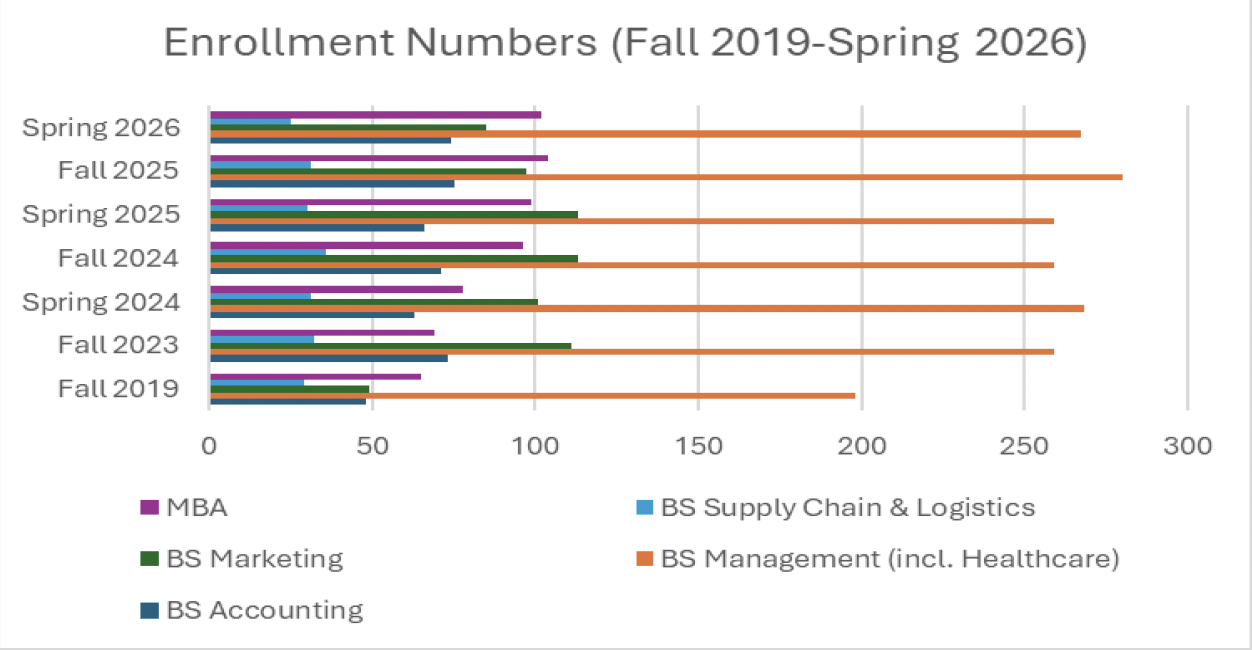
The enrollment data for the School of Business programs from Fall 2019 through Spring 2026 indicate overall growth across most academic programs, with the BS Management (including Healthcare Management) program consistently maintaining the highest enrollment levels.
BS Management (Including Healthcare Management) Program- remains the largest program within the School of Business throughout the period examined. Enrollment increased substantially from approximately 198 students in Fall 2019 to a peak of 280 students in Fall 2025, representing significant growth. Although enrollment experienced a slight decline to 267 students in Spring 2026, the program continues to serve the largest number of students and remains the primary driver of overall business enrollment.
BS Marketing Program- enrollment has shown consistent improvement over time. Student numbers increased from approximately 49 students in Fall 2019 to around 85 students in Spring 2026. While some semester-to-semester fluctuations are evident, the overall trajectory remains positive, indicating growing student interest in marketing-related career opportunities.
BS Accounting Program- experienced moderate but steady growth. Enrollment increased from approximately 48 students in Fall 2019 to approximately 74 students in Spring 2026. The
program has maintained relatively stable enrollment while demonstrating gradual gains over the seven-year period.
BS Supply Chain & Logistics Program- enrollment declined from 29 students in Fall 2019 to 25 students in Spring 2026, indicating a continued area of concern despite the growing workforce demand for supply chain and logistics professionals. This trend suggests the need for targeted recruitment, marketing, and industry engagement initiatives to increase student interest and enrollment in the program.
MBA Program- demonstrates a positive long-term trend. Enrollment increased from approximately 65 students in Fall 2019 to over 100 students in several recent semesters, reaching approximately 102 students in Spring 2026. The steady growth suggests continued demand for graduate business education and reflects successful recruitment and retention efforts at the graduate level.
Overall Observations
Several important trends emerge from the analysis:
- Total enrollment across School of Business programs has generally increased since Fall 2019. BS Management remains the dominant program and contributes the largest share of student enrollment. Marketing and Accounting have all demonstrated growth trends.
- The MBA program has maintained strong enrollment growth and remains above 100 students in recent semesters.
Number of Degrees Awarded by Degree Programs
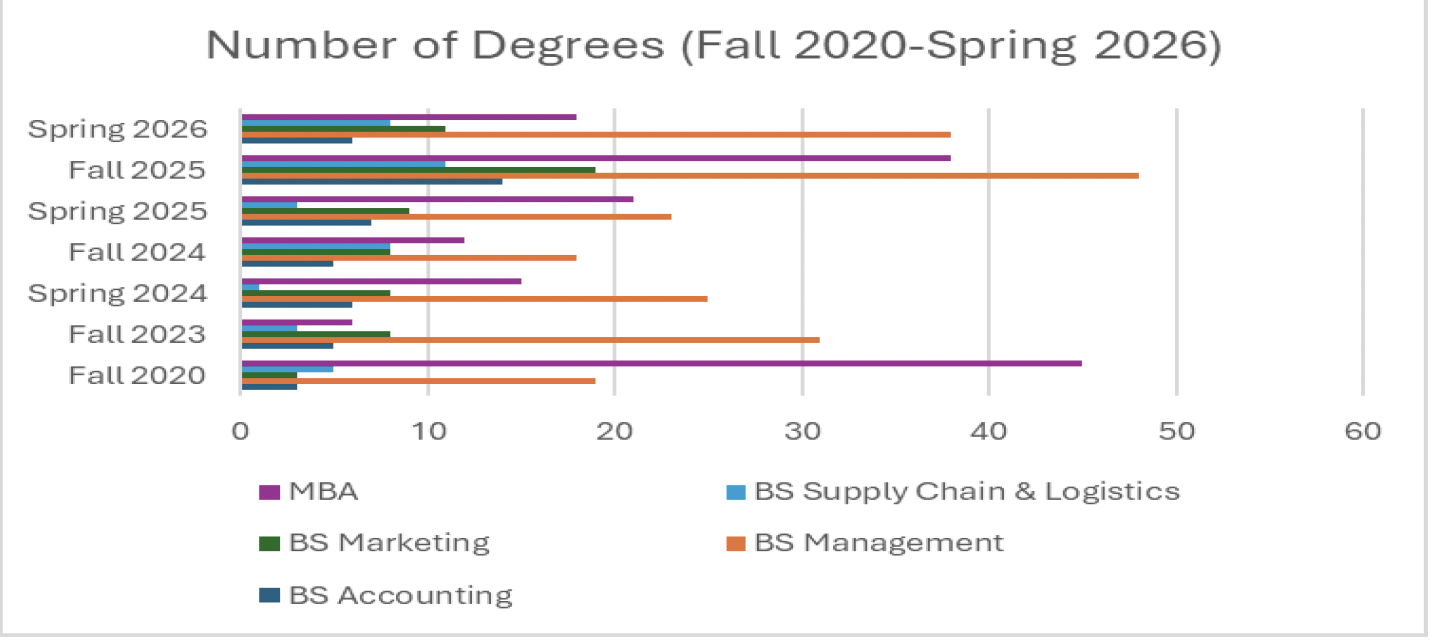
The degree completion data for the School of Business from Fall 2020 through Spring 2026 demonstrates strong and sustained degree production across all academic programs. The BS Management program consistently awarded the highest number of degrees, while the MBA program showed notable fluctuations with periods of exceptional graduation activity. Overall, the data indicates healthy program productivity and continued student progression toward graduation.
BS Management Program- remains the leading contributor to degree production within the School of Business. Degrees awarded increased from approximately 19 graduates in Fall 2020 to a peak of 48 graduates in Fall 2025, before declining slightly to 38 graduates in Spring 2026. Despite normal semester-to-semester variations, Management consistently produced the largest number of graduates, reflecting its position as the school’s largest academic program.
BS Marketing Program- remained relatively stable during the review period. Graduates increased from approximately 3 students in Fall 2020 to around 11 students in Spring 2026. While smaller in size than Management and MBA, the program consistently contributed graduates and demonstrated gradual improvement over time.
BS Accounting Program- maintained steady degree completion rates throughout the period. Degrees awarded increased from approximately 3 graduates in Fall 2020 to approximately 6 graduates in Spring 2026. The program experienced moderate fluctuations but generally sustained a consistent level of graduate output.
BS Supply Chain & Logistics Program- showed encouraging growth in production. The number of graduates increased from approximately 5 students in Fall 2020 to approximately 8 students in Spring 2026. Although still one of the smaller programs, the upward trend aligns with enrollment growth observed in recent years and suggests continued expansion of the program.
MBA Program- demonstrates significant graduation activity throughout the reporting period. Although the number of graduates fluctuated, the program continued to produce strong outcomes, with approximately 18 graduates in Spring 2026. These fluctuations are typical of graduate programs due to cohort-based enrollment patterns.
Overall Observations
Several important trends emerge from the analysis:
- BS Management program consistently produced the highest number of graduates and remains the School of Business's primary source of degree completion.
- The MBA program demonstrates significant graduation activity throughout the reporting period.
Fall-to-Fall Student Retention Rates in the Business Programs
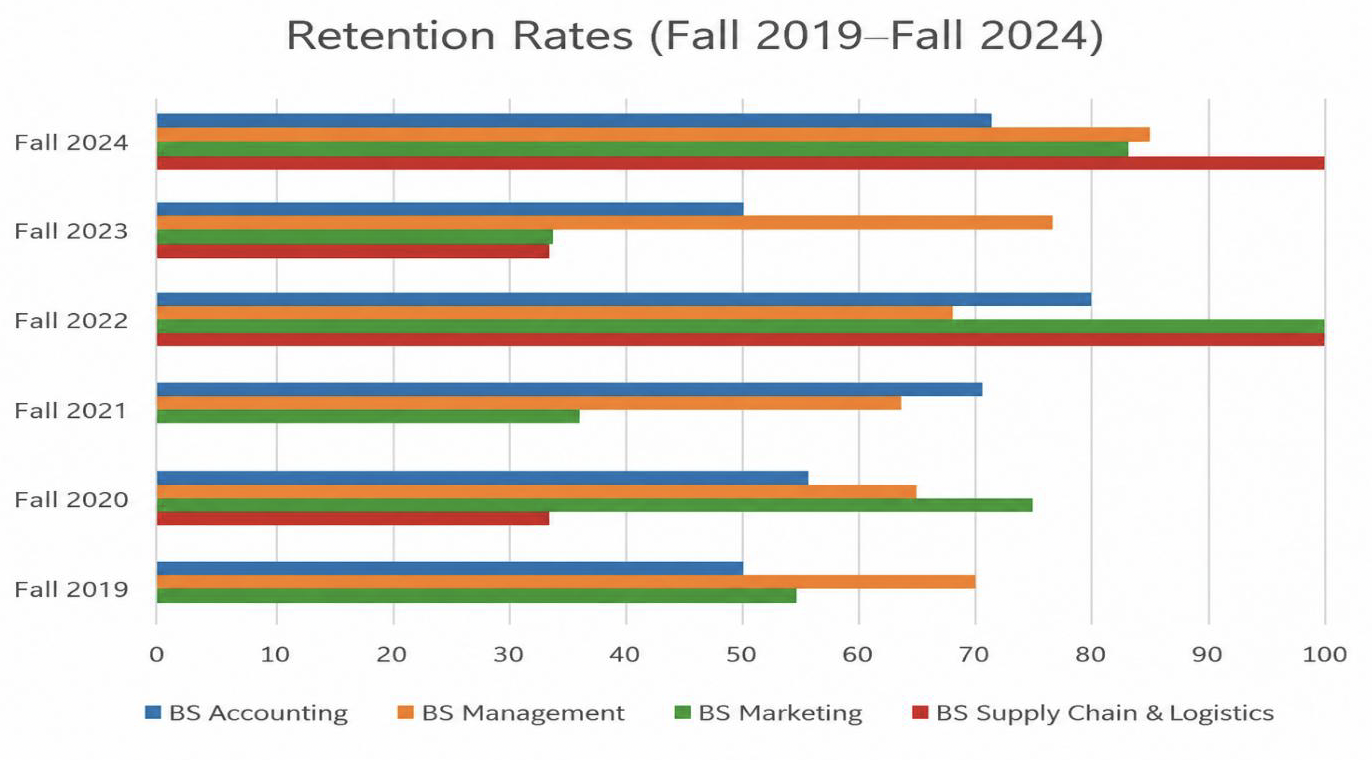
The retention data for the School of Business programs from Fall 2019 through Fall 2024 indicates generally positive student persistence across all academic programs. Although retention rates fluctuated during the reporting period, most programs demonstrated overall improvement by Fall 2024, suggesting that initiatives focused on academic advising, student engagement, faculty support, and student success have contributed positively to retaining students and supporting their progress toward graduation.
BS Management Program- consistently maintained the strongest and most stable retention rates among the undergraduate programs. Retention increased from 70.0% in Fall 2019 to 85.3% in Fall 2024. Although modest fluctuations occurred during the review period, the program consistently retained more than 60% of its students and remained the highest-performing program among the larger business majors.
BS Marketing Program- experienced greater variation in retention over the reporting period but demonstrated substantial overall improvement. Retention increased from 54.5% in Fall 2019 to 83.4% in Fall 2024. Following declines in Fall 2021 and Fall 2023, the program rebounded significantly, achieving one of its highest retention rates in Fall 2024. This improvement suggests that recent student support and engagement initiatives have positively influenced student persistence.
BS Accounting Program- demonstrated steady improvement throughout the review period. Retention increased from 50.0% in Fall 2019 to 71.4% in Fall 2024. While retention fluctuated over several years, the overall trend reflects increasing student persistence and continued program stability. The improvement observed in Fall 2024 represents the program's highest retention rate during the reporting period.
BS Supply Chain & Logistics Program- experienced the most dramatic changes in retention. Following an initial retention rate of 33.3% in Fall 2020, the program achieved 100% retention in both Fall 2022 and Fall 2024. Although retention declined to 33.3% in Fall 2023, the program rebounded to 100% the following year. Because the program enrolls a relatively small number of students, annual retention percentages are more susceptible to fluctuations; however, the results indicate that students who remain in the program are highly likely to persist toward degree completion.
Overall Observations
Several key findings emerge from the retention data:
- The retention rates generally improved across the School of Business between Fall 2019 and Fall 2024, reflecting positive outcomes from advising, student support services, faculty engagement, and retention initiatives.
- BS Management Program consistently maintained the highest and most stable retention rates among the larger undergraduate programs.
- BS Marketing Program showed significant improvement over the reporting period, increasing from 54.5% to 83.4%, despite some year-to-year fluctuations.
- BS Accounting Program demonstrated steady gains, improving from 50.0% to 71.4%, indicating stronger student persistence and program stability.
- BS Supply Chain & Logistics Program exhibited the greatest variability due to its smaller enrollment but achieved 100% retention in Fall 2022 and Fall 2024, demonstrating exceptional student persistence during those years.
Overall, the retention data suggest that the School of Business has strengthened its ability to retain students and support their academic progression, while continuing to identify opportunities for targeted interventions in programs experiencing greater year-to-year variability.
Student Performance in the Peregrine Inbound and Outbound Exam
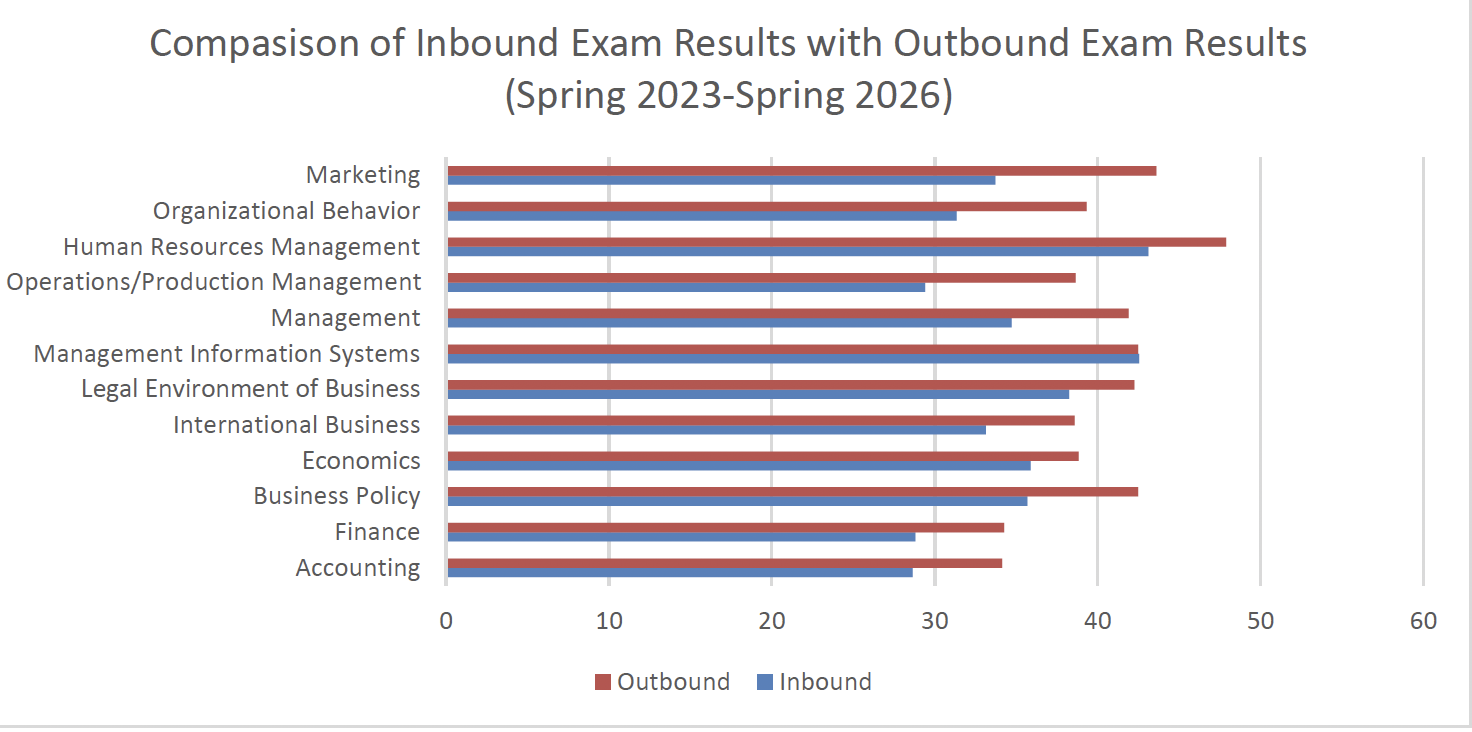
The comparison of inbound and outbound Peregrine examination scores provides evidence of student learning and knowledge development across key business disciplines within the School of Business. Overall, outbound scores exceeded inbound scores in most subject areas, indicating that students gained knowledge and competencies during their academic programs. The results demonstrate positive learning outcomes and support the effectiveness of the business curriculum.
Accounting- showed modest but positive improvement, with scores increasing from approximately 29% inbound to 34% outbound. While the gain was smaller than those observed in some other disciplines, the upward trend indicates measurable growth in accounting knowledge and principles over the course of students' academic programs.
Business Policy- demonstrated meaningful gains in student learning. Scores increased from approximately 36% inbound to 42% outbound, representing an improvement of approximately 6 percentage points. This outcome reflects students' increased ability to apply strategic management concepts and integrate knowledge across business disciplines.
Economics- showed positive improvement, with scores increasing from approximately 36% inbound to 39% outbound. This gain indicates that students developed stronger knowledge of economic concepts, market forces, and business-related economic decision-making.
0 10 20 30 40 50 60 Accounting Finance Business Policy Economics International Business Legal Environment of Business Management Information Systems Management Operations/Production Management Human Resources Management Organizational Behavior Marketing Compasison of Inbound Exam Results with Outbound Exam Results (Spring 2023-Spring 2026) Outbound Inbound
Finance- demonstrated measurable improvement, with scores increasing from approximately 29% inbound to 34% outbound. Although performance remained moderate, the increase suggests growth in students’ understanding of financial concepts, analysis, and decision-making.
Legal Environment of Business- showed growth, with scores increasing from approximately 38% inbound to 42% outbound. The improvement suggests that students gained a stronger understanding of legal, ethical, and regulatory issues affecting business decisions.
International Business- exhibited growth, with scores increasing from approximately 33% inbound to 39% outbound. The improvement indicates enhanced student understanding of global business environments, international markets, and cross-cultural business practices.
Human Resources Management- showed positive improvement, with scores increasing from approximately 43% inbound to 48% outbound. This gain indicates that students strengthened their understanding of staffing, employee development, performance management, compensation, and workplace policies over the course of their academic program.
Management- demonstrated improvement, with scores increasing from approximately 35% inbound to 41% outbound. This increase reflects stronger student knowledge of planning, organizing, leadership, decision-making, and core management principles.
Management Information Systems- showed no improvement, and on the contrary slightly reduced. Student scores fell from approximately 43% inbound to 42% outbound. These results suggest a need to integrate high impact teaching modalities when teaching information systems, technology applications, and data management concepts to the business students.
Marketing- showed positive improvement, with scores increasing from approximately 34% inbound to 44% outbound. The gain indicates growth in students’ understanding of marketing concepts, consumer behavior, market analysis, and business strategy.
Organizational Behavior- exhibited one of the strongest improvements among all assessed areas. The average score increased from approximately 31% on the inbound assessment to 39% on the outbound assessment, representing an improvement of approximately 8 percentage points. This substantial gain suggests that students develop a stronger understanding of individual, group, and organizational processes throughout their program of study.
Operations/Production Management- demonstrated the highest level of improvement across all subject areas. Scores increased from approximately 29% inbound to 39% outbound, reflecting a gain of nearly 10 percentage points. The significant increase indicates strong achievement in operations, process management, quality control, and production-related concepts.
Overall Findings
Several key trends emerge from the assessment results:
- Outbound scores exceeded inbound scores in every assessed discipline, demonstrating positive student learning outcomes across the curriculum.
- Accounting exhibited positive improvement, although additional attention may further strengthen student performance in this discipline.
- International Business showed steady growth and evidence of knowledge acquisition.
- Organizational Behavior and Business Policy also demonstrated substantial increases, reflecting effective instruction and curriculum alignment.
- Operations/Production Management achieved the largest improvement, indicating particularly strong learning gains in this area.